

The Delhi High Court is set to pronounce its verdict today in a batch of petitions challenging the constitutional validity of Exception provided in Section 375 of the Indian Penal Code (IPC). The exception effectively provides that charges of rape cannot be attracted against a man who has non-consensual sex with his wife.
The High Court has been seized of the matter since 2017 but it was only in January 2022 that a division bench of Justices Rajiv Shakdher and C Hari Shankar started hearing final arguments in the matter.
After hearing the petitioners, two amicus curiae and those opposing the petitions for over 20 days, the court finally reserved its judgment on February 21.
The Central government had refused to take a clear stand on the issue on the ground that there needs to be wider consultation with all stakeholders which required more time. The plea by the Centre to defer the hearing was turned down by the Court.
Here are brief summaries of the arguments made by counsel appearing on all sides:
Petitioners
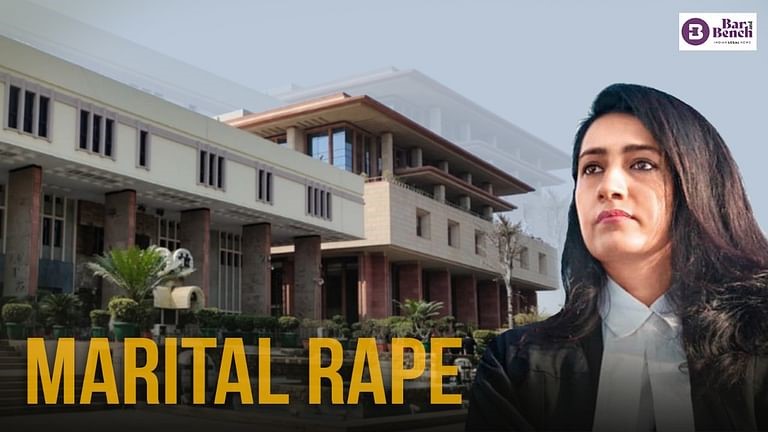
Advocate Karuna Nundy and Senior Advocate Colin Gonsalves addressed arguments on behalf of the petitioners.
Karuna Nundy
- The object of rape laws is to ensure that women are not raped. Retaining the Exception under Section 375 will nullify the very object of rape laws;
- Exception under Section 375 is unconstitutional because it gives primacy to the institution of marriage over the individuals in the marriage;
- Exceptions provided in a statute on criminal law cannot subsume the object of the main provision;
- On the issue of creation of a new offence if the exception is struck down, Nundy said that the court will not be creating a new offence since the offence already exists. Striking down the exception will only bring within the ambit of the offence, a new class of people;
- Marital rape violates a woman’s right to dignity, personal and sexual autonomy and her right to self-expression enshrined under the Constitution of India.
Colin Gonsalves
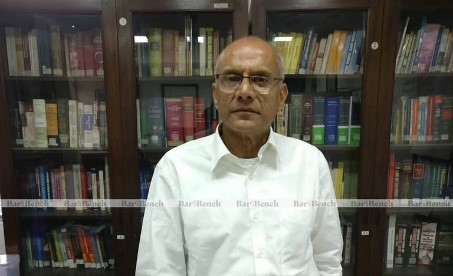
- Time has come now for such a huge crime to be redressed immediately. There can be no ifs or buts and no qualification or caveats;
- Quantification of punishment for marital rape should be left to the parliament to decide;
- Trial courts will develop jurisprudence on the issues of coercion and consent over a period of time through judgments;
- Possibility of misuse of law, false complaints, different punishment, impossibility of evidence, should not deter the courts from striking down an unconstitutional provision.

Senior Advocate Rajshekhar RaoNLSIU Moot Court Society Facebook Page
Rajshekhar Rao
- It is not reasonable, just and fair in today’s age to deny the wife a right to call rape a rape;
- Status of marriage between two parties cannot be sufficient reason to deny a wife the ability to prosecute her husband for marital rape;
- Section 375 is predicated on the issue of consent, or the lack of consent, the indirect effect of the exception has been to obliterate the consent altogether;
- Independent Thought judgment by the Supreme Court read down the same exception and it said that it was not creating an offence, since the offence already existed under Section 375.
Rebecca John

Rebecca John
- Woman’s consent is essential to the immunity provided to husbands through Exception 2 of Section 375;
- If a woman is subjected to sexual intercourse without her consent, then the exception to Section 375 of the Indian Penal Code should be viewed as an instrument of oppression;
- Expectation of sex in marriage cannot result in forceful sexual relations;
- If marital rape is criminalised, charges of attempt to rape will also be attracted against a husband;
- When a law is framed or a statute promulgated, there is an assumption of constitutionality, legislature’s powers cannot be suppressed through judicial review;
- Court has a much larger role to protect civil liberties and therefore it must protect the liberties of husbands by retaining the Exception under Section 375.
Advocate Raj Kapoor Opposing criminalising non-consensual sex.
- Wife cannot compel parliament to prescribe a particular punishment against her husband just to satisfy her ego;
- Non-consensual sex between a husband and wife cannot be labelled as rape and, at worst, it can be called sexual abuse.
- Striking down Exception 2 has the potential to destroy the institution of marriage since a wedding is not only a union between two individuals, but also affects the children as well as the entire family;
- Parliament has made a classification based on the gravity or intention of an offence, there is a limit on the powers of judicial review;
- Powers of a High Court under Article 226, cannot be equated with the powers of Supreme Court, which in the cases of Joseph Shine, Navtej Johar and Independent Thought did not create an offence, but merely read down a section of the penal code or decriminalised an offence.
Central government

Solicitor General of India Tushar Mehta
Though the Union Government had, in its initial affidavit, opposed the petition arguing that the criminalisation of marital rape has the potential to destroy the institution of marriage, Solicitor General for India Tushar Mehta later appeared before the court and said that it was not the government’s stand now.
Mehta said that the government has started a consultative process on the issue and has sought the view of various stakeholders including the States but it is not yet ready with a decision on whether it is opposing or supporting the petitioners.
The government, therefore, asked the Court to defer the hearing which was disallowed.
BY ADVOCATE RAJKUMAR PAHUJA